


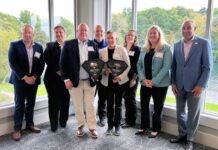

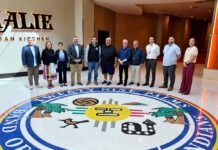






























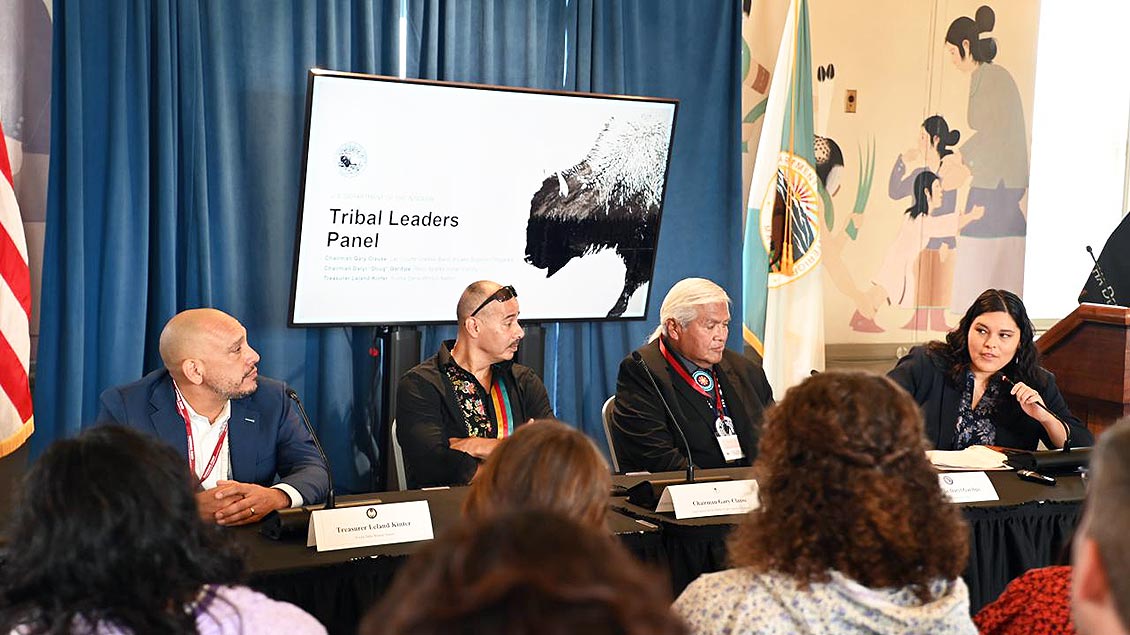
WASHINGTON, D.C. – Tribal leaders, school administrators, language teachers, and students from across Indian Country gathered at the U.S. Department of the Interior for the Forum on Native Languages and Education. The full-day convening on Native language revitalization was organized by the Office of the Assistant Secretary for Indian Affairs and the National Fund for Excellence in American Indian Education, the congressionally chartered foundation for the Bureau of Indian Education (BIE).
The forum brought together presenters from tribal nations, BIE-funded schools, tribal colleges, and Native language organizations to share what is working in their communities. Sessions covered language and technology, tribal language programming, Office of Indian Economic Development Living Languages Grant Program grantees, and grantees of the Native Language Program operated by the BIE in partnership with the National Fund.
“Native languages are a foundation of Native identity and communities. President Trump recognized the importance of Native language when he became the first president to meet with and honor Code Talkers in the Oval Office in 2017, noting that the preservation of Native languages supported victory in WWII. Today, this work supports the educational and personal success for Natives across the country,” said Assistant Secretary for Indian Affairs Billy Kirkland. “This forum demonstrated that the knowledge and expertise to sustain and revitalize Native languages already exists within our communities. The Trump administration is supporting and working to ensure tribes have resources and flexibility to lead language revitalization efforts in their own communities.”
Through Native Language federal funding, more than $12.5 million has been made available to 17 BIE-funded schools to expand Native language programs, instruction, and immersion programming. These schools also receive access to specialists in language curriculum development, instructional materials design, program evaluation, and early childhood immersion methods.
“What these schools are showing us is that language is not separate from student success. It runs through it,” said Heath Clayton, Lead Executive Officer of the National Fund for Excellence in American Indian Education. “Our job is to get resources into the hands of the people doing this work every day, and then get out of their way.”
Several schools presented early results at the forum. Turtle Mountain Community High School in Belcourt, ND, reported that Anishinaabemowin, the Ojibwe language, is now taught across five class periods daily, with an after-school language club open to any student.
“We are seeing students show up differently when their language is part of their school day,” said Cindy Keplin, Assistant Principal at Turtle Mountain Community High School. “That is what this funding made possible.”
In a survey of language program participants, 67% showed improved daily attendance, with some gains as high as 8.6% points, and 58% improved their grade point average, with gains ranging from 0.04 to 0.62 points. Turtle Mountain also reported that 511 language-eligible students took part in Anishinaabemowin activities during the January through March 2026 quarter.
Santa Fe Indian School described a program serving students from more than 23 Native language communities across six languages, built around Pueblo language teachers and a shared Native Language Philosophy developed with participants from seven Pueblos.
The forum also previewed the National Native Language Summit, which the National Fund and the National Indian Education Association will convene October 6 in Buffalo, NY, bringing together educators, students, researchers, and language advocates from across Indian Country.