













































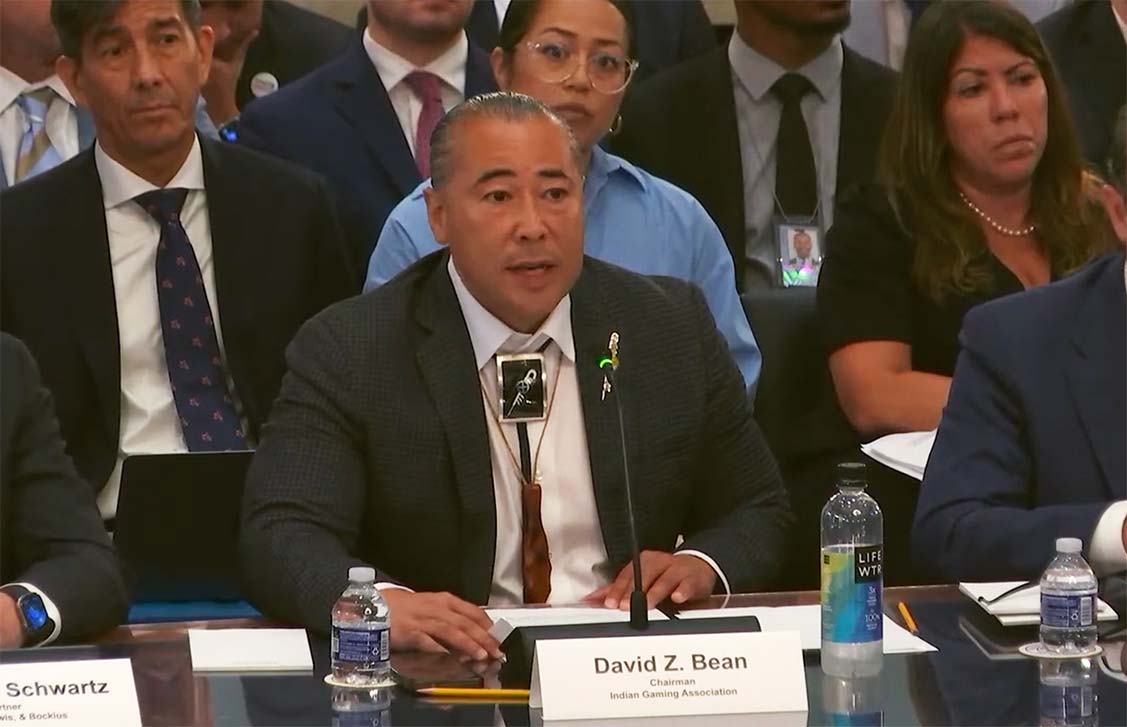
WASHINGTON, D.C. – Indian Gaming Association Chairman David Z. Bean testified before the U.S. House Committee on Agriculture, Subcommittee on Commodity Markets, during the hearing, “Examining Customer Protections and Market Integrity in Sports Event Prediction Markets,” calling on Congress to preserve tribal sovereignty, protect consumers, and stop the continued expansion of sports gambling through federally regulated prediction markets.
Representing the Indian Gaming Association and its member tribes from across the country, Chairman Bean urged lawmakers to reaffirm that decisions regarding sports wagering belong to tribal and state governments, not federal financial regulators.
“The issue before Congress today is much larger than sports betting,” said Chairman Bean. “This is about protecting tribal sovereignty, preserving the integrity of the Indian Gaming Regulatory Act, defending rural economies, and ensuring that consumers, especially young people, are protected through the responsible regulatory systems that tribes and states have spent decades building.”
During his testimony, Chairman Bean emphasized that Indian Country supports responsible innovation and legitimate financial markets, but strongly opposes the use of Commodity Futures Trading Commission-regulated prediction markets to expand nationwide online sports gambling outside established tribal and state gaming laws. He warned that these platforms are bypassing long-standing consumer protections, responsible gaming safeguards, and age restrictions that tribal governments have invested decades establishing.
Bean explained that Indian gaming was created to strengthen tribal governments and provide sustainable funding for essential governmental services, including healthcare, education, housing, public safety, infrastructure, and economic development.
“Indian gaming is not simply about casinos,” Bean told the Subcommittee. “It is the economic foundation that allows tribal governments to provide essential services for their citizens and create opportunity in rural America. Every dollar generated through Indian gaming is reinvested back into our communities.”
Chairman Bean also warned that prediction markets are undermining both tribal and state regulatory authority while targeting consumers who live in jurisdictions where online sports betting remains illegal.
“Prediction markets have not invented a new financial product,” said Bean. “They are offering the same sports wagers found in traditional sportsbooks while avoiding the consumer protections, regulatory oversight, responsible gaming requirements, and local accountability that tribal and state governments require. No one voted for this expansion of gambling, and Congress never authorized it.”
Bean noted that tribal governments collectively invest hundreds of millions of dollars annually in gaming regulation and employ thousands of regulators dedicated to protecting the integrity of gaming operations and safeguarding consumers. Those investments include responsible gaming programs, strict age verification, fraud prevention, licensing, regulatory oversight, and partnerships with federal and state agencies. Prediction market operators, he argued, avoid these obligations while benefiting from federal regulatory inaction.
Throughout his testimony, Chairman Bean outlined three actions Congress should take to restore local control over sports wagering policy:
- Advance H.R. 7840, the Event Contract Enforcement Act, to reaffirm existing federal law prohibiting sports gambling through prediction markets.
- Ensure the CLARITY Act explicitly preserves the Indian Gaming Regulatory Act, tribal sovereignty, and state gaming laws by prohibiting sports and casino-style gambling through prediction markets.
- Reject the Commodity Futures Trading Commission’s proposed rule that would eliminate longstanding prohibitions against gaming-related event contracts and further expand federally regulated online gambling.
“The debate over sports wagering has always belonged to tribal governments and states,” concluded Bean. “Congress created the Indian Gaming Regulatory Act to recognize tribal authority and establish a proven regulatory framework built on integrity, accountability, and local decision-making. We respectfully ask Congress to reaffirm that framework, protect consumers, and preserve the sovereign rights of tribal nations for generations to come.”
The Indian Gaming Association has worked alongside tribal governments, state regulators, national organizations, and bipartisan members of Congress to oppose the expansion of sports gambling through prediction markets, arguing that these platforms threaten tribal sovereignty, diminish critical government revenues, undermine consumer protections, and erode the regulatory framework established under the Indian Gaming Regulatory Act.